SIMPL





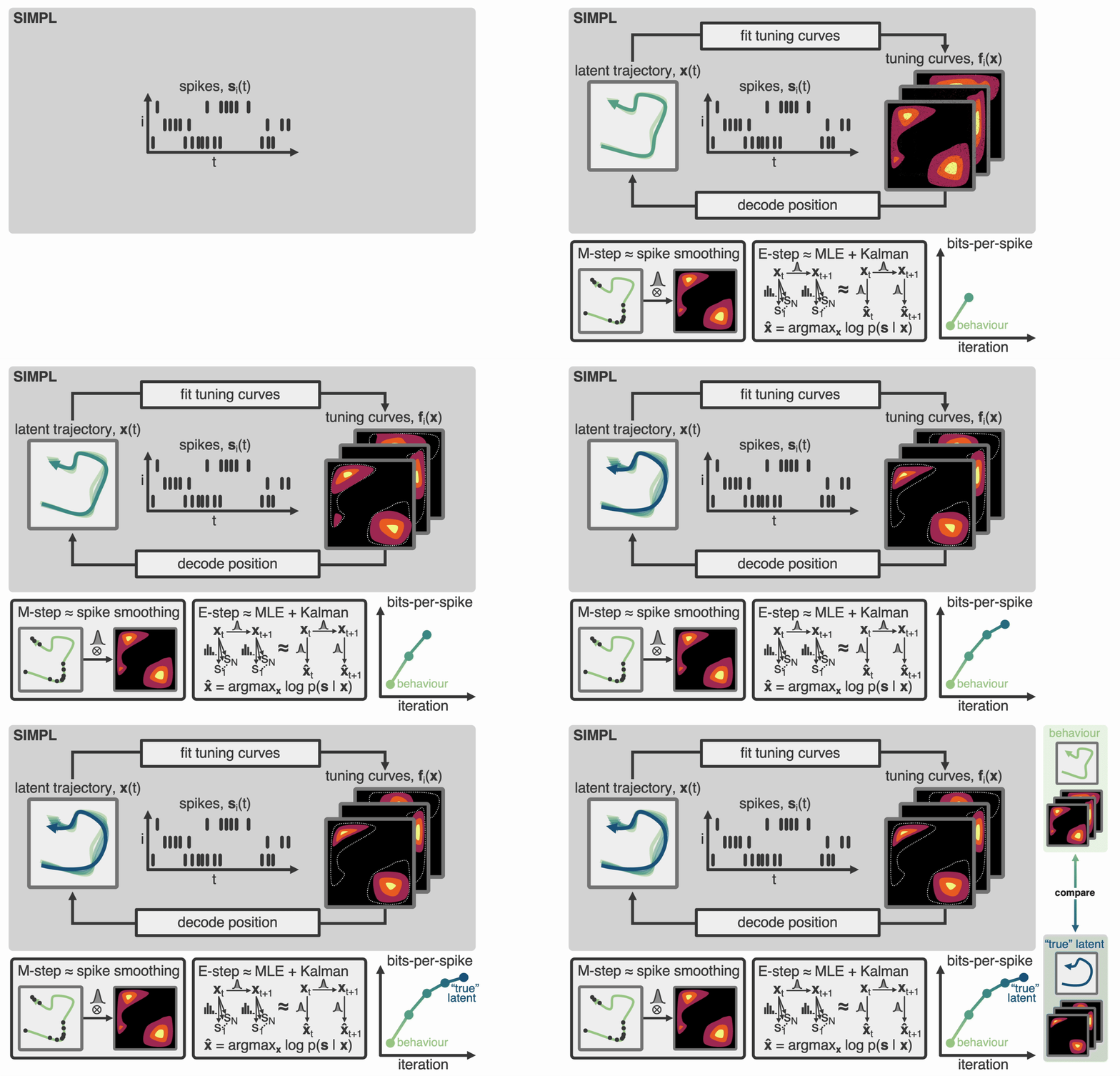
A JAX-python package for optimising latent representations and neural tuning curves from spike data. It does this by iteratively decoding the latent and fitting the tuning curves, starting from behavior or stimuli. It is lightweight, scalable, and very fast. Published at ICLR 2025.
Key Features
- Fast — fits 200 neurons over 1 hour of data in under 10 seconds on CPU. GPU optional but rarely needed.
- Scalable - scales to state-of-the-art size neural datasets (1000s of neurons, millions of time points, billions of spikes) on CPU.
- Simple — scikit-learn API. Minimal hyperparameters. Get started in <10 lines of code.
- Flexible — 1D, 1D angular (e.g. head direction), 2D spatial (e.g. place/grid cells), and higher dimensional data all permitted. Trial-structure aware. Temporal or non-temporal data.
- Rich outputs — results stored as
xarray.Datasetwith per-iteration variables, metrics and units. - Visual — built-in plotting for trajectories, receptive fields, spike rasters, and fitting summaries.
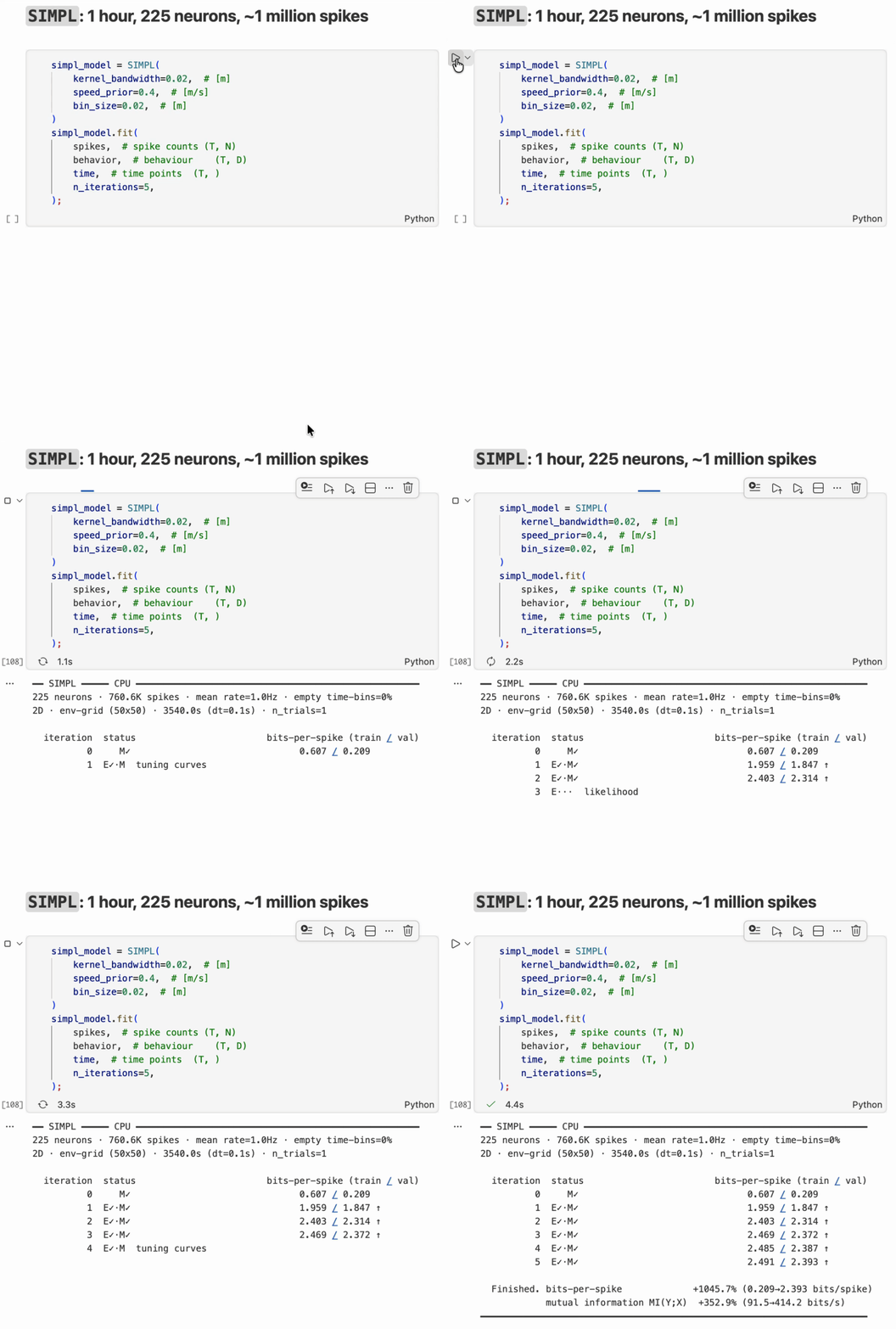
Neural data analysis in < 5 seconds
Installation
pip install simpl-neuro
To run the demo notebook locally (or else )
pip install "simpl-neuro[demos]"
simpl demo                # downloads demo notebook into the cwd
If you need GPU, use the platform-specific instructions in GPU Acceleration.
See the Quickstart for the core workflow, Examples/Demos for complete walkthroughs, or Code & Docstring Reference for raw docstrings.
Cite
If you use SIMPL in your work, please cite it as:
Tom George, Pierre Glaser, Kim Stachenfeld, Caswell Barry, & Claudia Clopath (2025). SIMPL: Scalable and hassle-free optimisation of neural representations from behaviour. In The Thirteenth International Conference on Learning Representations.
@inproceedings{
    george2025simpl,
    title={{SIMPL}: Scalable and hassle-free optimisation of neural representations from behaviour},
    author={Tom George and Pierre Glaser and Kim Stachenfeld and Caswell Barry and Claudia Clopath},
    booktitle={The Thirteenth International Conference on Learning Representations},
    year={2025},
    url={https://openreview.net/forum?id=9kFaNwX6rv}
}